FIELD NOTES · 6 MIN READ
How to Identify an Authentic Wayuu Bag: A Thoughtful Buyer’s Guide
Origin, construction, transparency, and the questions that matter more than a perfect label.
Begin with origin and transparency
A Wayuu bag should be connected truthfully to Wayuu makers and the La Guajira territory. Ask where the piece was made, who supplied it, what materials and techniques were used, and whether the seller clearly describes its own role.
Be cautious when a retailer uses Indigenous imagery but offers no origin information, no construction details, and no explanation of whether it is maker-owned, a cooperative, an importer, or a reseller.
Look at how it is built
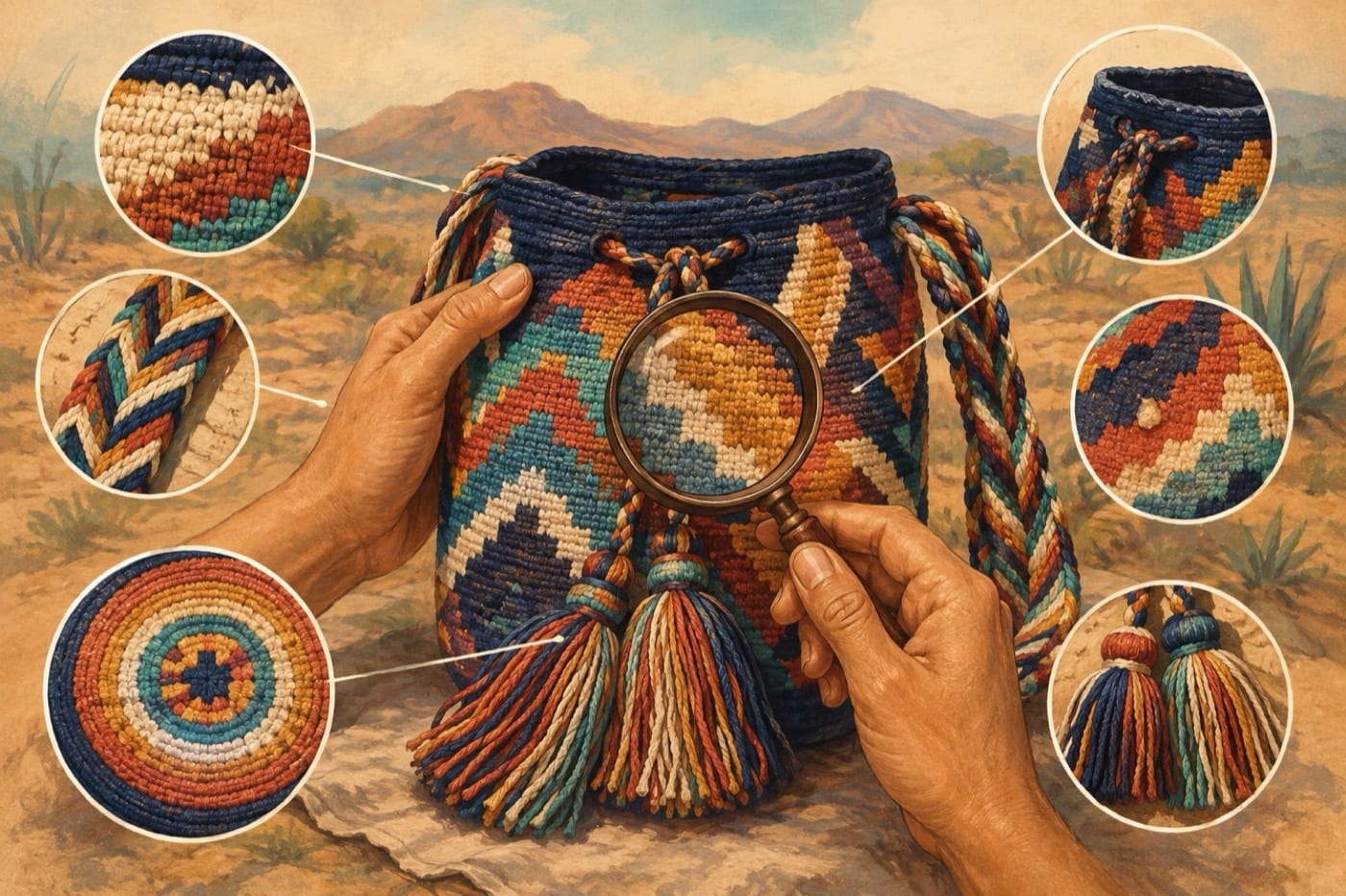
The recognizable shoulder mochila commonly combines a crocheted body with a woven or braided strap, drawstring, and finished cords or tassels. Colombia’s official craft reference identifies the base, body, opening, strap, cord, design, and tassels as key parts of the form.
Inspect evenness rather than mechanical perfection. Handmade variation is expected, but the body should feel stable, the opening should be finished, and the strap should be joined securely.
Do not rely on myths
Bright color alone does not prove authenticity. Neither does a geometric motif, a high price, or a romantic product story. Contemporary Wayuu makers work with varied palettes and both inherited and evolving designs.
Likewise, acrylic yarn is not evidence that a bag is fake. Colombia’s protected denomination for Wayuu weaving recognizes both natural cotton yarn and industrial acrylic fibers.
Respectful buying is an ongoing question
There is no single visual checklist that can reveal every labor relationship behind a product. Better buying depends on traceability, honest representation, and sellers who do not claim an identity they do not hold.
Look for clear information about where a piece was made, how it was sourced, and the people and techniques behind it. Those details help customers judge a relationship accurately instead of being led by implication.
A practical eight-point checklist
Use this as a buyer checklist rather than a guarantee: verify origin language, technique disclosure, even construction and finished edges, respectful pattern descriptions, realistic pricing, honest material disclosure, clear returns and contact details, and a real public source for any denomination or certificate claim.
No single photo proves everything. Ask the seller where the bag was woven, whether Wayuu authorship is clear, how the technique is described, and what support exists after purchase.
Yarn fiber and Wayuu authorship
Acrylic yarn does not automatically make a Wayuu bag inauthentic. Yarn fiber alone cannot establish or erase Wayuu authorship. Community, place, technique, and honest sourcing context are more useful than fear-based fiber claims.
Public guidance from Artesanías de Colombia and Colombia’s Superintendency of Industry and Commerce provides better cultural-product context than an unnamed seal invented by a seller.
Red flags worth another question
Pause when an authentic-Wayuu claim offers no origin detail, when handwork pricing has no plausible explanation, when a certificate is not named, or when an artisan biography reads like an uncheckable marketing prop. Pressure tactics are not evidence. Stay curious, ask for specifics, and compare the answer with published policies.
SHOP THE GUIDE
Compare the pieces
QUICK ANSWERS
Frequently asked questions
What is the best first authenticity check?
Look for clear Wayuu and La Guajira origin language, then ask how the technique and sourcing are documented.
Does acrylic yarn make a Wayuu bag fake?
No. Fiber alone does not determine Wayuu authorship or origin.
Is a high price proof of authenticity?
No. Price is one clue, but origin, technique, construction, and policy clarity matter more.
Should every seller have a fair-trade certificate?
No. Any certificate claim should name a real, checkable program. An unnamed badge is not proof.
Learn more
References and related reading for this article: